

Today’s grab bag question is:
Is it illegal to make cold sales calls using AI agents?
Not necessarily, but it’s riskier than using humans. To reduce risk AI cold calls:
-
Don’t call personal telephone numbers. Call email addresses using VOIP services like FaceTime audio or Google Voice. U.S. telemarketing rules only affect calls received on a phone number assigned by a telephone carrier. You can still call from a phone number: what matters is whether the call’s endpoint is a telephone number.
-
If an AI agent is calling personal phone numbers, it shouldn’t launch into a defined script or canned message when a person picks up. It’s got to be conversational. An AI agent which is hard to distinguish from a human caller may never lead to the type of legal proceeding that would squarely address the attractive, but flawed, theory that AI cold calls are illegal. But let’s dive into why that theory’s become ubiqutuous, and how it misses the mark.
Legal landscape
Ready for some disgusting acronym soup? The two main bodies of law at play in the U.S. sound exactly the same. But they carry wildly different consequences. Here’s a broad-strokes summary.
| Law | Regulator | Scope | Penalties | Enforcement |
|---|---|---|---|---|
| TCPA (‘91) | FCC | Contacting consumers using common-carrier phone lines | $500 per violation1 | 250,000 private lawyers2 |
| TCFPA (‘94)3 | FTC4 | Deception and fraud in telemarketing5 | Actual damages | FTC, state Attorneys General6 |
Don’t mess with the TCPA
This post focuses on the FCC’s rules under TCPA, not the somewhat overlapping rules issued by the FTC under the TCFPA (including—ready for a migraine?—the Telemarketing Sales Rule).
Why? TCPA violations carry fixed statutory damages, and any lawyer in this country can sue you to recover them. Each of those is a big fucking deal. If you endure a nonconsensual telemarking call, what’s the dollar value of your suffering? Is yours the same as mine?
The TCPA answers those questions: $500 each. Fixed damages remove any doubt about the value of a TCPA lawsuit. That firms up the range of potential outcomes, which incentivizes settlement. The plaintiffs’ lawyers who bring TCPA claims love to settle. Their take of the outcome usually stays the same (30-40%) whether it takes two days or two years to resolve a claim. By contrast, the TCFPA doesn’t answer those questions, and unless $50,000+ in harm results from a violation, only FTC and state Attorneys General can enforce it. Public authorities target egregious noncompliance with their limited resources. For example, a business that makes AI agents and sells them to other businesses for use in telemarketing might be a ripe target. Targeting a customer of that business would have much less impact. You can find a pretty good 2023 analysis of AI-cold-call liability under the TCFPA at TCPAWorld7. In a nutshell, the FTC’s rules only govern “prerecorded” marketing calls.
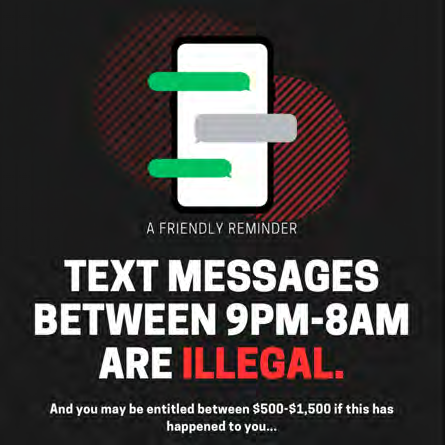
Allow of this explains why you may have seen an Instagram ad inviting you to join a class-action lawsuit over nonconsensual SMS. The allure of the TCPA’s bright-line rule—no commercial SMS without prior consent—and fixed, $500/violation damages explains why. Unlike text messages, not all cold calls require prior consent. But other bright-line rules do apply:
- No cold-calls to anyone enrolled on the National Do Not Call Registry.
- Follow the “quiet hours” rules8 that always bar commercial calls between 9pm and 8am local time.
- Cold callers must maintain their own “mini” Do Not Call list for those who opt out to them, log all calls and opt-outs and limit the number of times they call anyone on an unsolicited bases
That’s about it for calls made by human beings. Calls involving “artificial or prerecorded voice” are subject to additional, stringent TCPA rules.
“Artificial” makes that sound new, but the phrase dates from 1991. And today’s question stems from a misunderstanding of how language from 1991 applies today.
The main rule
Under the TCPA, prior consent to make a call if an “artificial or prerecorded voice” delivers “a message” that includes advertising or constitutes telemarketing.9 Congress required the FCC to flesh out the TPCA with rulemakings, including by creating exceptions to that very provision for services in the public interest.10 Today’s TCPA rules reflect what the FCC has woven into the statutory text. The FCC’s formulation of this rule has grown clunkier with age. Here’s how it reads today, in relevant part:
No person or entity may… (3) Initiate any telephone call to any residential line using an artificial or prerecorded voice to deliver a message that includes or introduces an advertisement or constitutes telemarketing without the prior express written consent of the called party…
A telephone call to any residential line using an artificial or prerecorded voice to deliver a message requires no consent if the call: …. (iii) Is made for a commercial purpose but does not include or introduce an advertisement or constitute telemarketing and the caller makes no more than three calls within any consecutive 30-day period to the residential line and honors the called party’s request to opt out of future calls as required in paragraphs (b) and (d) of this section; …
Yuck. To break it down: a cold call must do these things to violate clause (3):
(A) go to a residential line + (B) use an artificial or prerecorded voice + (C) deliver a message that:
- (1) includes or introduces an advertisement or
- (2) constitutes telemarketing
Let’s consider some ways a business could avoid running afoul of that rule.
Easy: Don’t call a “residential line”
- Don’t call phone numbers. Place calls to email addresses known or believed to be associated with free11 VOIP services like FaceTime Audio.
- Don’t call ‘residential lines’. The TCPA protects consumers. That does include personal cell phones, but excludes business and commercial lines.
Harder: Don’t “deliver a message”
Let’s say your AI agent begins a call with “Hi Mary, I’ll be honest, this is a cold call from [insert AI startup], could I have a few minutes of your time?” Is that a message? More broadly, is that call initiated to deliver a message?
Going off the plain language alone, you might say “sure.” From our perch in 2025, it’s easy to think of a call as a series of messages, or perhaps something that altogether “delivers a message.”
And it doesn’t help that today’s regulation has it both ways. In the first formulation—the prohibition at (3)—the message must encompass an ad or constitute telemarketing. In the second formulation—the safe harbor at (3)(iii)—the call must not encompass an ad or constitute telemarketing. Ugly! Since the regulatory text is a mess, it’s worth considering how courts and the FCC have applied the language to facts on the ground.
The “soundboard” cases address prerecorded messages, not live but artificial operators
The FCC and courts have not really addressed what constitutes a message, as opposed to a call. So we’ll turn to the plain language, and Congressional intent, in a minute. But here’s what legal cases have contributed to the question:
In its most relevant decision, the FCC commissioners fractured over whether calls comprised of prerecorded soundboard clips fell into the prohibition. In 2020, three commissioners — a majority of the five —found soundboard calls to require prior consent, even if selected or monitored by a human.12 The decision broke no new ground, and like all court and FCC discussions of the rule to date, addresses only “prerecorded” voice messages:
There is no doubt that soundboard technology “uses” a prerecorded voice to deliver a message to the consumer—the petitioners do not argue this point. We disagree that the TCPA’s use of the singular “message” in the phrase “to deliver a message” demonstrates that Congress did not intend the TCPA to restrict calls that involve multiple prerecorded or artificial voice messages as opposed to one uninterrupted message using such technologies. Calls that include multiple such messages by necessity include single message. …To find otherwise could lead to an absurd result, e.g., a caller playing two sound snippets back-to-back to avoid obtaining consumer consent. The absurdity there is semantic, since back-to-back prerecorded messages may just as well be a message. But, to avoiding conflicting with a 1995 Ninth Circuit decision13, the FCC limited its ruling to calls that begin with an artificial or prerecorded message, not those that begin with a “live operator”:
Our ruling, however, is limited to calls that are initiated using an artificial or prerecorded voice message that the record suggests is the common practice on calls using soundboard technology. [P]etitioners offer no such example of artificial or prerecorded messages having been introduced by a live operator on a call using soundboard technology before playing an artificial or prerecorded message. Apparently, it is not absurd that there’s no liability if a live operator says the “Hi Mary” piece and leaves the rest to a series of prerecorded message. Neither the Ninth Circuit nor the FCC confronted a call conducted by a live but artificial operator—nor, as far as I can tell, has any court since. So let’s do what the FCC hasn’t and consider what Congress meant by “deliver a message.”
The real meaning of a “message”

When Congress enacted the TCPA in 1991,14 the difference between a call and a message was more concrete. Messages had long been what they handed when you got back to the office. And there was a new DIY option: you could check your voicemail messages at home by rewinding a cassette tape that had recorded them (they called it an ‘answering machine’). At the time, artificial voices couldn’t conduct live calls; they could only deliver messages. Let’s review some of the floor debate:
Automatic dialing machines… have the capacity to call 20 million Americans during the course of a single day, with each individual machine delivering a prerecorded message to 1,000 homes. … The compromise bill makes it unlawful for any person to initiate any telephone call to any residence using an artificial or prerecorded voice to deliver a message.
The legislation makes two absolute exceptions to this prohibition: First, where there is the prior express consent of the called party; and second, where the call is initiated for emergency purposes, [like] any automated telephone call that notifies consumers of impending or current power outages. —Rep. Markey, Nov. 26, 1991
In other words, an automated message about a power outage required an exception to this rule. By contrast, a call from a live operator would not:
I regard…robotic calls by machines such as autodialers and computer-generated voices to be a much greater threat to the privacy of our homes than calls by live operators. At least you can vent your anger to a real person if they have interrupted your dinner. You can ask them questions and hold them accountable to some extent. At least a live person can only call one person at a time. Among calls placed by live operators, there are some that we may not mind so much. Some are even helpful. —Rep. Cooper, Nov. 26, 1991
Another sought to give the FCC rulemaking authority so it could exempt messaging services viewed as advancing consumer interests without harming consumer privacy. At the time, the hot new service MessagePhone could deliver “messages” on your behalf if the line you needed to reach was busy:
Take for instance the scenario where you are at an airport, you missed your flight and only have a few minutes to call your spouse with the updated flight information. The line is busy and you have to leave. With my constituent’s service, you could record a message; they would attempt to deliver a few minutes later, even if you were completely removed from a telephone...MessagePhone designed the service to give the calling party an alternative to busy and unanswered telephone calls which make up 30 percent of all telephone calls. —Rep. Bryant, describing the need to exempt MessagePhone
Congress wasn’t just talking about messages: the distinction between calls and messages was written into the TCPA and remains papered throughout the regulations today. Look at clause (2), which sits above clause (3). It applies to a narrower set of recipients, and excludes the “deliver a message” proviso:
(2) Initiate, or cause to be initiated, any telephone call that includes or introduces an advertisement or constitutes telemarketing, using an automatic telephone dialing system or an artificial or prerecorded voice, to any of the lines or telephone numbers described in paragraphs (a)(1)(i) through (iii) of this section, other than a call made with the prior express written consent of the called party…
That means “deliver a message” in clause (3) must have meaning, whether anyone wants it to or not. What does it mean? Forget Congressional intent—just consult a dictionary:
**message** | ˈmesij

1 a verbal, written, or recorded communication sent to or left for a recipient who cannot be contacted directly: *if I'm not there, leave a message on the voice mail.*

*US English* an official or formal communication, especially a speech delivered by a head of state to a legislative assembly or the public: *the president's message to Congress.*

an email or similar electronic communication: *select an option to delete your mail messages.*

an electronic communication generated automatically by a computer program and displayed on a screen: *an error message.*

a divinely inspired communication from a prophet or preacher: *Jesus and his followers were promulgating a specifically Judaic message for Judaic adherents.*

*US English* a television or radio commercial: *we will return after these messages.*
In each case, (1) the act of saying, writing or recording a communication precedes (2) the delivery or transmission of the communication to the recipient. (Lest we forget, that remains true of most voicemail: “If you are satisfied with your message, please press pound to confirm or 1 to rerecord.”) That is what makes something a message. When the act is simultaneous with its delivery, it’s not a message. It’s a conversation. And when it’s on the phone, it’s a call.
And the FCC now has separate rules now specify exactly what “artificial and prerecorded voice telephone messages” must say.15 That long list supplies further context demonstrating that a message is canned or scripted, not an open-ended dialogue or conversation. The FCC’s soundboard case built its conclusion that “the record confirms that soundboard callers use a prerecorded voice to deliver a message” along just those lines:
- “Based on consumer complaints and press reports,” the soundboard dialogues did not “represent a normal, continuous, two-way conversation” because, among other things, the recordings do not always respond to consumer questions and the call is terminated in response to such questions.
- “the record indicates that soundboard agents routinely monitor multiple telephone calls simultaneously while rarely, if ever, speaking on these calls, and that the prerecorded messages they use are sometimes nonsensical to the consumer.”
A call with an AI agent need not begin with, nor ever include, a message. It wouldn’t involve a prerecorded voice, either. The point of using an AI agent would be to facilitate an unscripted, responsive dialogue—just the kind a human caller would conduct.
Forget it: a cold call’s going to involve ads or “telemarketing”
Even if an AI agent “delivers a message,” that’s not the end of the story. But the last escape hatch from the consent requirement is fraught with subjectivity, and is a shakier basis for avoiding TCPA liability than the other options. Today’s clause (3) ends with carve-out from the prior-consent requirement for several kinds of calls using artificial or prerecorded voices, as long as they aren’t telemarketing and lack ads. The carve-out mirrors everything from the prohibition—the carved-out calls still deliver a message—the difference is only whether the call includes an ad or constitutes telemarketing. And those calls can be commercial in nature—that’s (3)(iii).
So, it must be true that some commercial cold calls using artificial voices deliver messages but don’t require prior consent: the ones that don’t include ads or constitute telemarketing.16
That’s MessagePhone delivering the audio clip your spouse recorded before the flight took off. Or your pharmacy’s robotic voice saying your prescription’s ready. The AI cold calls the questioner’s talking about will eventually alight on a sales pitch. Assuming the call is found to have begun with a message, there’s the telemarketing, and that’s the ballgame.
Future proofing
Will this change? It’s not clear to me why AI agents would be more annoying or bothersome than human callers, except in so far as AI calls would be cheaper to make. AI agents will probably pantomime sympathy and speak more clearly than the average call-center worker (for whom English is often a second language). And most human agents already follow a deterministic script—you can easily imagine a generative system that cuts through a lot of that routine noise. But, as uptake of AI rises in telemarketing, we may see a spike in the sheer number of unsolicited calls, as we have with unsolicited text messages.17 That deluge may prove to be such an annoyance that future regulations address this fact pattern more specifically. But right now, none have been proposed. Follow the TCPA rules that do exist for all unsolicited calls — get the National Do-Not-Call list, set up your business’ own do-not-call list and policy, ensure your agents identify themselves and can add anyone who opts out, track your calls, etc. — and you’ll be fine.
1. The FCC itself can seek larger penalties, but even in egregious cases, rarely exceeds $1,000 per violation. That’s what it fined the business responsible for placing the fake-Biden robocalls ahead of the 2024 New Hampshire primary.
2. Section 227(b) —Restrictions on the use of automated telephone equipment — includes a private right of action. 47 USC 227(b)(3).
3. E.g. the Telemarketing and Consumer Fraud and Abuse Prevention Act (1994), as amended in 2001 and 2010. 15 USC 6101 et seq.
4. The Federal Trade Commission issues and enforces federal trade rules, including the general prohibition on false, deceptive or misleading trade practices. That law is the genesis of regulations like the subscription-autorenewal restrictions that went into effect earlier this year.
5. Telemarketing means a plan, program, or campaign which is conducted to induce the purchase of goods or services or a charitable contribution, by use of one or more telephones and which involves more than one interstate telephone call. 16 CFR 310.2(ii))
6. Okay, technically a called party can sue if they suffer more than $50,000 in damages as a result of a “pattern or practice” that violates the TCFPA. Needless to say, those are serious frauds, not the stuff of everyday noncompliance. 15 U.S. Code § 6104(a).
7. ITS COMPLICATED: So Is the Use of Outbound AI for Marketing Purposes on Purchased Leads Illegal? Ummm…[)]
8. No calls “before the hour of 8 a.m. or after 9 p.m. (local time at the called party’s location)”. TCPA regs § 64.1200(c)(1)(1)).
9. In 1991, Congress passed this language, which remains the heart of the more fleshed-out regulation in effect today:
…to initiate any telephone call to any residential telephone line using an artificial or prerecorded voice to deliver a message without the prior express consent of the called party, unless the call is initiated for emergency purposes or is exempted by rule or order by the Commission under paragraph (2)(B);
10. All FCC TCPA rulemaking activity is visible here.
11. “Free?” you might think. How the hell would I know? Today that’s a risk a business placing cold calls must run, but it’s hard to make a fearsome class action out of the few people who do get charged to take a call. In 1991, numbers weren’t portable among cell and landlines, and VOIP didn’t exist. In the North American Number Plan days, a number’s prefix reliably indicated whether it was “assigned to a paging service, cellular telephone service, specialized mobile radio service, or other radio common carrier service, or any service for which the called party is charged for the call.” So you’d’ve know whether you were flirting with that danger—TCPA Section (a)(1)(iii)—the earlier provision of the TCPA that says any unsolicited call using an autodialer or “artificial or recorded voice” is illegal if placed to person who gets charged for the call (no “message” required).
Even under the ‘91 TCPA text, it’s hard to square the tension between that and Section (b), which contains the exemptions we’ve been discussed in this post. Now the FCC itself takes the position that cell phones (a “cellular telephone services” under (a)) are “residential” (and thus subject to the exemptions in (b)), creating a head-on collision between the adjacent statutory clauses. A call to a cell phone that’s flat illegal under (a) can’t be exempted by anything the FCC adds to (b).
So the FCC lubed up some guardrails against friction between a literal reading of Section (a)(1)(iii) and the rest of the TCPA, adding the exemptions at 47 CFR 64.1200(a)(1)(iv). But a few businesses still get dinged by the professional plaintiffs who use chargeable VOIP and prepaid plans for this reason. See Perrong v. Victory Phones (E.D. Pa. July 15, 2021) (finding no tension because (b)(1)(B)’s exemption for residential calls only applies to landlines, per a 2013 appellate decision); contra Stoops v. Wells Fargo Bank, NA. 197 F. Supp. 3d 782 ( W.D. Pa. 2016) (plaintiff who purchased 35 cell numbers and used prepaid minutes in order to file TCPA suits lacked standing as a consumer).
12. In the Matter of NorthStar and Yodel, Dec. 18, 2020.
13. “Under the [TCPA], prerecorded messages may be used only if a live operator introduces the message or if the consumer consents.” <a href="https://law.justia.com/cases/federal/appellate-courts/F3/46/970/591418/
">Moser v. FCC (9th Cir. 1995).
14.
15. 47 CFR 64.1200(b) ) (“All artificial or prerecorded voice telephone messages shall…” )
16. This phrase in the carve-out mirrors the language of the prohibition. I think it’s ultimately irrelevant, whether it’s scoped to a call or a message, for the practical reasons set out in the post. But let’s think about how it could apply to a “a message”, from a legal perspective:
“includes or introduces an advertisement”: Okay, “includes” clearly targets prebaked advertisements (the message “includes” an ad). It says “includes” so tacking on a non-ad phrase doesn’t become a get-out-jail-free card. Then it gets weird. “Introduces” seems intended to target sequenced recordings, where a recipient’s response could trigger a live person to take over the call (“introduces” an ad). But that doesn’t actually work, because the regulations define “advertisement” as material that advertises. 47 CFR 64.1200(f)(1)(1)). Neither a live person nor their voice is a “material.” It’d be odd to say “then she said an advertisement.” Something prerecorded or printed? That’s material you can use. In other words, it’s hard to imagine an artificial or prerecorded voice merely introducing an advertisement without including it.
“Introduces” makes even less sense in the carve-out, where the context is supposedly the entire “call” as opposed to a “message.” How can a call introduce an ad it excludes? It can’t: you’d be talking about a different call entirely. So what is doing in the carve-out? Occam’s razor: when the FCC amended the regulation to add the carve-out, it had two choices. (A) Clear up the preexisting, baffling language in the prohibition. (B) Leave the subject alone by repeating it verbatim. It chose option (B).
Whatever. These days, when the FCC talks about this rule, it just says “includes.”
“constitutes telemarketing”: this seems like a circular nothingburger. The TCPA regulations don’t define “telemarketing” (at least, not that I can find). The FTC’s TCFPA regulation do define it: “a plan, program, or campaign which is conducted to induce the purchase of goods or services”. Going off that definition, it’s hard to imagine a message that constitutes, unto itself, a “plan, program or campaign.” A plan, program or campaign would, almost by definition, consist of many messages or calls.
17. E.g., “Good morning! How are you doing today? Did you see my picture?😊” // “Hello, my name is Emily, recruiter at DSL, we came across your profile through several online recruitment platforms and were impressed by your background and experience, we’re currently offering a flexible part-time opportunity that you can work on in your free time. The role involves assisting TEMU merchants with product reviews. It’s a straightforward task, and we’ll provide free training to get you started. The daily salary ranges from $201 to $3000, and you can receive your commission immediately after the work is completed.”